
When a brand says “limited edition,” skepticism is reasonable. The term has been used so often, and so carelessly, that it has lost nearly all meaning. Limited edition t-shirts. Limited edition sneakers. Limited edition fragrances that reappear every season.
At Umbra Studio, each work exists in exactly nine copies. The edition closes when complete. No reprints. No exceptions. No tenth copy held in reserve.
This is not a marketing policy. It is a structural decision — and it has real consequences for those who collect.
The problem with “limited edition” without a number
A limited edition without an exact number is not a limited edition. It is a vague promise. Limited to how many? Until when? Who verifies that no further copies are ever printed?
The specific number is what makes scarcity verifiable. Nine copies means there are exactly eight other people in the world who own the same work. That is a fact, not a feeling.
In the collectible fine art print market, the edition size is one of the factors appraisers use to determine resale value. Not the only one — the artist’s trajectory, the work’s significance, its condition also matter — but one of the first things consulted. An edition of nine is not the same as an edition of fifty. And fifty is not the same as five hundred.
Why nine and not fewer
It could be five. It could be three. A single unique copy would be, in theory, absolute scarcity.
But a unique work has a problem: it is unrepeatable for anyone who doesn’t arrive first. Collecting has a collective dimension that the unique object destroys. An edition of nine allows the work to exist in nine distinct contexts — nine spaces, nine conversations, nine acquisition histories — without losing its character of rarity.
Nine is also the last number before the cycle resets in many numerological traditions. The boundary of what can be complete without ceasing to be finite. It is not a coincidence that we chose this number. It is a position.
What “closed edition” means in practice
When the ninth copy of a work leaves the print laboratory and reaches its owner, that work ceases to exist as an available work. Permanently.
There is no waiting list that reactivates. No reprint justified by demand. No version in another size that circumvents the limit.
What this means for the collector is concrete: if a work interests you and two copies remain, there are exactly two other people in the world who can acquire it. When they are gone, they are gone.
This mechanism is not designed to manufacture urgency. It is designed so that the urgency is real.
Handwritten numbering as act, not formality
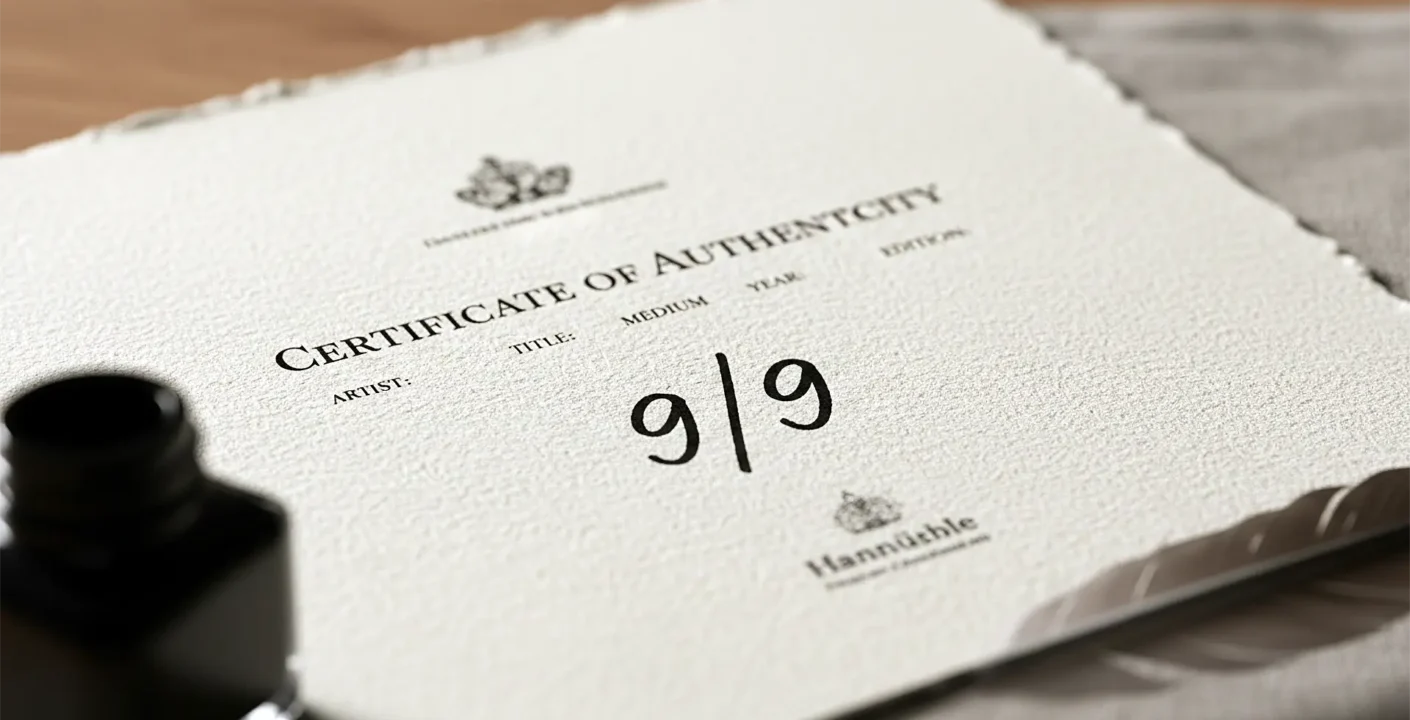
Each copy carries its edition number written by hand: 1/9, 2/9, through 9/9. The number is not printed — it is written. In ink. By a hand.
Some galleries and studios print the numbering directly onto the work or certificate. It is faster and more uniform. At Umbra Studio we do not do this because handwritten numbering is a statement: someone held this work in their hands and left a mark on it. That is traceable. That is verifiable. That is part of the object.
The Hahnemühle Certificate of Authenticity that accompanies each work records the title, edition number, size and paper. Not as bureaucracy: as part of the chain of custody that turns a print into a collectible work with a history.
The difference between real scarcity and manufactured scarcity
Manufactured scarcity is created artificially to simulate value. Stock managed deliberately to make something appear rarer than it is.
Real scarcity results from an irrevocable production decision. When Umbra Studio prints nine copies and closes the edition, there is no mechanism to undo that decision. There is no printer reserved for commercial emergencies. There is no back-room inventory.
The experienced collector knows how to tell the difference. The question they ask is not “how many are left?” but “can I verify that the edition is genuinely closed?” The answer at Umbra Studio is always the same: the certificate carries the number. The number does not lie.
Who this matters to
Not everyone. And that is fine.
Someone looking for a beautiful image to decorate a wall has cheaper and more accessible options. Umbra Studio does not compete in that market.
Someone looking for an object with its own identity, with a verifiable production history, with the certainty that there will be no eleventh copy at an art fair three years from now — that collector understands exactly why the nine matters.
Scarcity is not the product. It is the condition that makes the product possible.
→ Check current availability by collection Some works are in their final copies. The edition does not reopen.
Want to understand what else determines the value of a fine art print beyond edition size? Read: What makes a fine art print worth what it costs