
Limited Edition Prints — Closed Editions of 9
In the art market, “limited edition” can mean almost anything. It can be a run of 500 with room to expand. It can be an edition of 50 that becomes 50 more once the first batch sells out. It can be a marketing term with no documentary commitment behind it.
At Umbra Studio it means one thing: nine impressions per work, hand-numbered, signed, with an individual certificate of authenticity, and with no possibility of reprinting once the edition is complete. This is not a commercial policy. It is the definition of what we make and why it makes sense to collect it.
What a Closed Edition Is — and Where It Comes From
A closed edition is one in which the total number of impressions is fixed before the first one is produced and cannot be modified once the run has begun. The edition exists as a complete, defined set from the moment the number is decided — not from the moment the last impression changes hands.
The distinction matters: when Umbra Studio establishes an edition of 9, it does not mean “we will print until demand reaches 9.” It means there are exactly 9 in the world, whether sold or not.
A Tradition Rooted in Printmaking
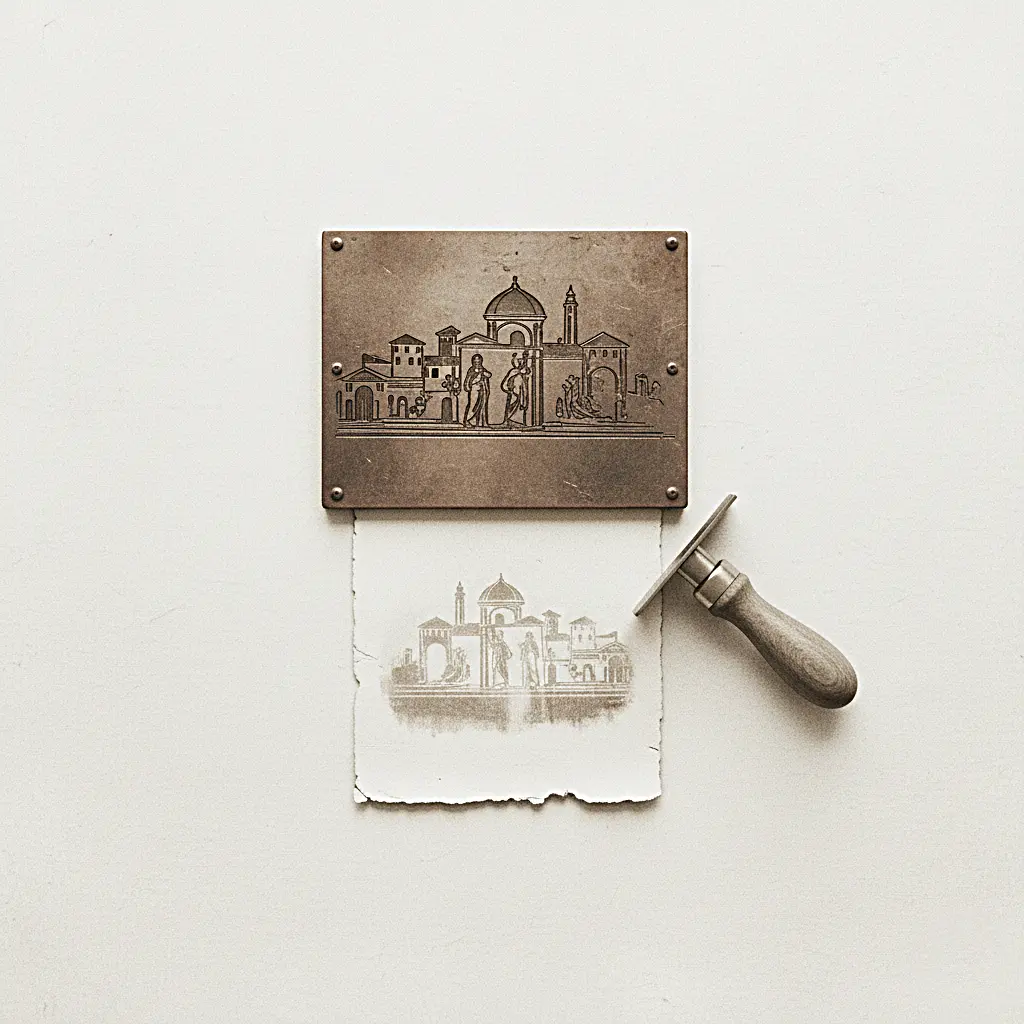
The closed edition did not begin with contemporary art. It has a genealogy stretching back to the engraving workshops of the sixteenth century, where limiting the edition was an inevitable material consequence: the copper plate, the lithographic stone or the woodblock matrix degrades with each impression.
Dürer numbered his woodcuts. Rembrandt distinguished the states of his etchings. Goya documented the print runs of Los Caprichos. Numbering was, in every case, an act of transparency: it told the buyer how many versions of that work existed in the world and what quality to expect given the state of the matrix.
When digital printing eliminated the physical degradation of the matrix, the closed edition ceased to be a technical necessity and became an ethical decision. Umbra Studio maintains it because the underlying argument has not changed: the collector has the right to know exactly how many versions of that work exist.
Closed Edition versus Open Edition: a Difference the Market Understands
An open edition — or a work with no declared edition — can be reprinted indefinitely as long as demand exists or the file remains available. It is a perfectly legitimate model for decorative reproduction, editorial publishing and commercial illustration.
For collecting it is another matter. A work without a closed edition has no verifiable scarcity, and without verifiable scarcity there is no rarity component — the element that defines collectible value in the secondary market. This is not a question of visual quality or material: it is a question of structure.
Why Exactly 9 Impressions
The number is not arbitrary, nor the result of a sales projection. It is the answer to a specific question: how many impressions can a work have for any collector to verify, with reasonable certainty, that the scarcity is real?
The answer, in the high-end collectible fine art segment, is a number that anyone can count. Ten or fewer. Preferably fewer than ten.
The Logic of the Small Number
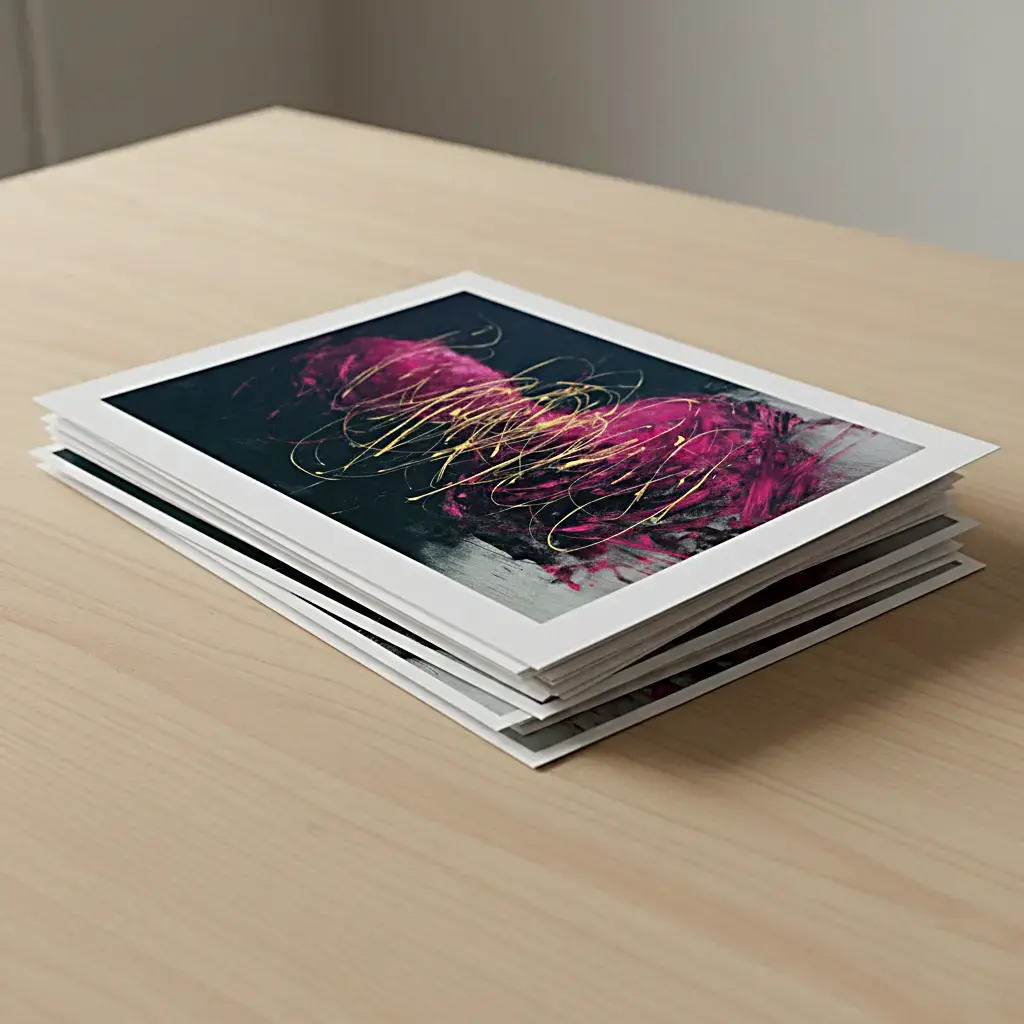
Editions of 50 have their market. Editions of 100 do too. But with those numbers, scarcity begins to feel abstract: “50 people own this work” is a true statement but a difficult one to internalise. “9 people own this work” is a statement any buyer can process immediately and concretely.
Nine is also the number that establishes a clear distinction from standard reproduction editions, which rarely fall below 25 or 50 impressions for reasons of unit economics. An edition of 9 absorbs a significantly higher production cost per impression, which implies an appropriate entry price and a market position that does not compete with decorative volume reproduction.
What Changes When Scarcity Is Verifiable
Verifiable scarcity has concrete consequences in market behaviour. When a collector knows that only 8 other people in the world own the same work, the buying decision changes in nature: it moves from a consumption decision to a decision of patrimonial acquisition.
This is not a promise of appreciation — no art market guarantees that — but a description of the logic that drives the serious collector: documented scarcity is the starting point of collectible value. Without it, there is decoration. With it, there is collecting.
Position Within the Edition: Does Your Number Matter?
One of the most common questions from buyers new to limited edition collecting is whether the position number within the edition affects value.
The honest answer is: it depends on the market, and in the contemporary fine art market, the answer is yes — with qualifications.
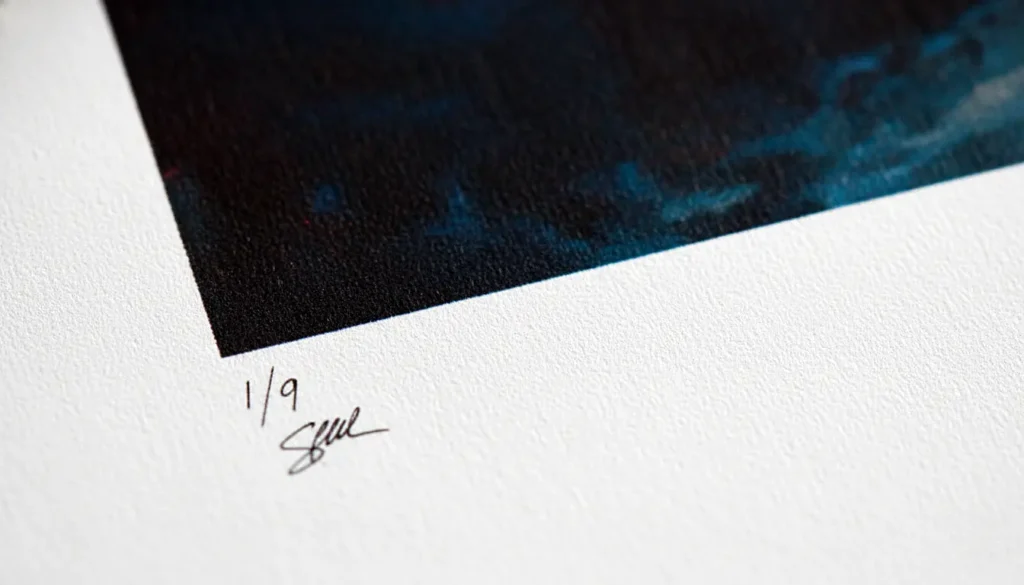
1/9 versus 9/9: What Secondary Market Data Shows
In the contemporary fine art print and graphic art market, impressions with low numbering — particularly 1/9 — tend to achieve higher prices in the secondary market than higher-numbered impressions, when the artist’s or studio’s work has gained value over time.
The reason is not irrational: the first impression is, by tradition, the one the artist or studio directs to the most committed buyer or most trusted client. It is also the impression most likely to have been inspected with the greatest rigour before being incorporated into the edition.
For Umbra Studio, all 9 impressions of each work are materially identical in print quality and substrate. The number in the margin is a document of position within the edition, not an indicator of differential quality. But the market has its own memory, and that memory attributes additional value to low numbers — a fact it would be dishonest to ignore.
Why Umbra Studio Does Not Reserve Artist's Proofs
Some galleries and studios retain “artist’s proof” impressions — typically marked AP — outside the standard numbering, which can be released into the secondary market at a later date.
Umbra Studio does not issue Artist’s Proofs or studio reserves outside the numbered edition. The 9 impressions of each work are the only 9 that exist. No reserves, no format variants, no institutional editions outside the standard run. When the ninth impression leaves the studio, the work is permanently sold out.
Numbering and Signature: Two Documentary Acts
The numbering and signature are not aesthetic gestures inherited
from the tradition of the engraving, though they are also that.
They are, above all, acts that establish the individual identity
of each impression within the edition and bind it to its certificate irrevocably.
The Fraction as Identity Document
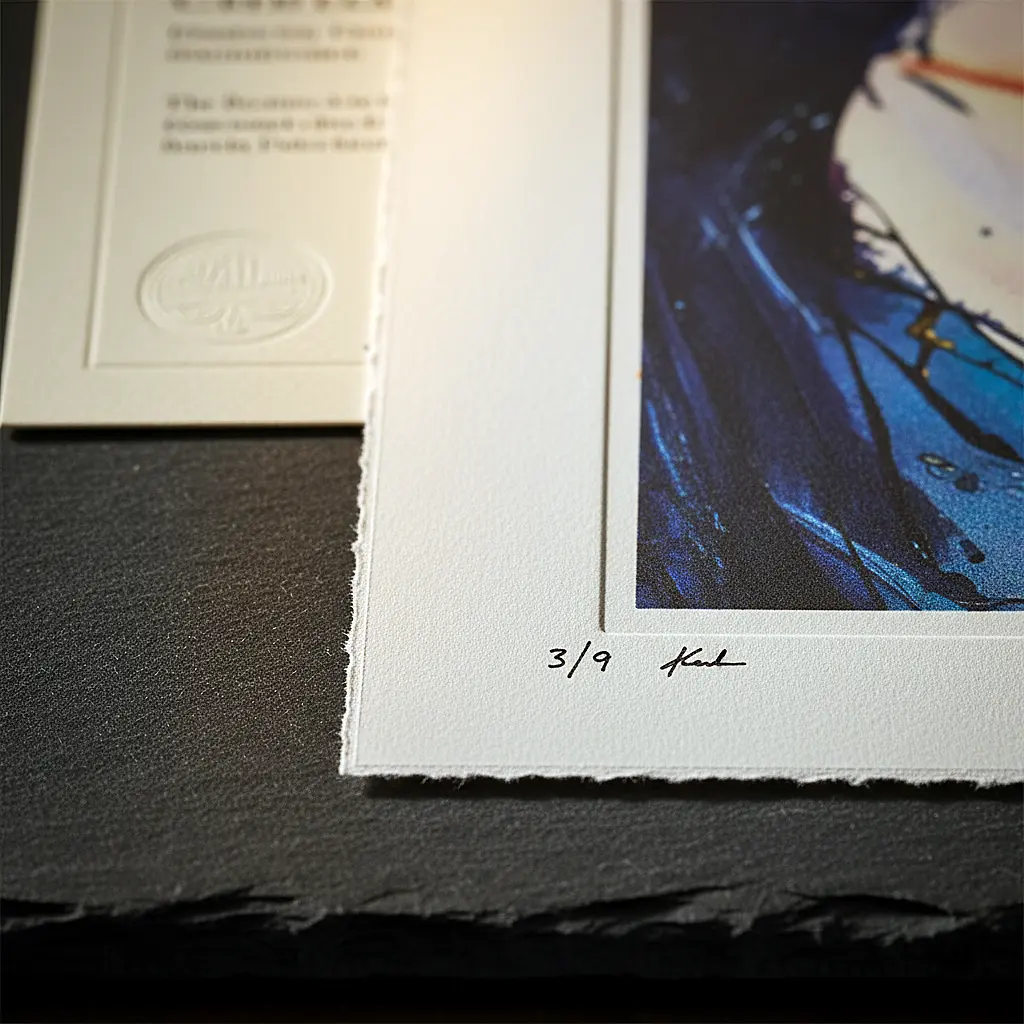
Each impression is numbered in the lower margin of the paper with the fraction of its position within the total: 1/9, 2/9, 3/9, through 9/9. The fraction contains two simultaneous pieces of information: the place this specific impression occupies within the edition, and the total size of that edition.
A collector who acquires impression 4/9 knows, simply by reading the margin fraction, that 3 impressions precede theirs and 5 follow, and that the total edition is 9. No certificate required. No external registry to consult.
The numbering also makes counterfeiting detectable: if someone attempted to produce a hypothetical “10/9”, the fraction itself would expose the forgery.
The Signature and Its Role in the Authenticity Chain
The studio signature in the margin establishes that the impression has passed internal quality inspection and has been formally incorporated into the edition. It is not an artist’s signature in the romantic sense of the term — Umbra Studio is transparent about the use of artificial intelligence tools in its process — but a studio signature that certifies acceptance of the impression into the edition.
The same signature appears on the certificate of authenticity accompanying the work, establishing the link between the physical object and its identity document.
The Certificate of Authenticity: What It Contains and Why It Matters
The Umbra Studio certificate of authenticity is not a presentation brochure or a courtesy document. It is the permanent documentary record of the complete identity of the impression, and it travels with the work each time it changes hands.
The Certificate Fields and What Each Certifies
- Title of the work: the definitive name, as it appears in the catalogue.
- Collection: which series the work belongs to (Bonsai, Liminal, Stoa…).
- Impression number / edition size: the fraction (e.g. 4/9).
- Substrate: Hahnemühle Photo Rag 308gsm with full technical specifications.
- Technique: archival pigment giclée printing.
- Dimensions: of the printed image and total paper size.
- Year of creation and date of printing: two distinct data points provenance requires.
- Studio signature and seal: physical binding to the object.
Why the Physical Certificate Matters More Than Any Digital Record
In the current debate around digital authentication — NFTs, blockchain, cloud registries — the physical collectible art market has reached a practical conclusion: the physical certificate, correctly documented, signed and associated with the object, remains the most robust authenticity instrument for the printed work.
Digital registries can be compromised; platforms can disappear; standards change. A certificate on archival paper, signed and stored with the work, carries none of those vulnerabilities. When a collector needs to insure the work, have it appraised, loan it to an institution or include it in a patrimony inventory, the physical certificate is what counts.
Limited Editions and the Secondary Market
Buying an Umbra Studio fine art edition is not a guaranteed investment. Art carries no assured returns, and any claim to the contrary would be both false and counterproductive for the collector who makes informed decisions.
What is true is that the factors which enable a work to hold or gain value in the secondary market — verifiable scarcity, certified material quality, documented provenance, irreversible closure of the edition — are all present in every Umbra Studio work.
The edition of 9, once exhausted, cannot be replenished. When the last impression has found an owner, the only way to acquire that work is through the secondary market, where the price is set by the dynamic between whoever holds it and whoever wants it. The studio does not participate in that dynamic or influence it.
Browse the limited edition collections → Explore all collections
About the printing technique and material substrate → Giclée Prints — The gallery technique → Museum papers — Hahnemühle 308gsm
For corporate acquisitions or interior design projects → [Business and prescriptor programme]