

There is a question that deserves an honest answer.
When someone sees a work at Umbra Studio and then opens Etsy in another tab, the comparison seems reasonable. Two prints. Two images. Very different prices. What justifies the difference?
The answer is not marketing. It is manufacturing, material and verifiable scarcity — all three, simultaneously.
The paper is not a detail. It is the work.
Toda impresión fine art de Umbra Studio se produce sobre Hahnemühle Photo Rag 308 g/m². Para quien no lo conozca: Hahnemühle es una papelera alemana fundada en 1584, proveedora histórica de artistas como Durero y Rembrandt, y actualmente el estándar de referencia en museos, galerías y colecciones privadas de primer nivel en todo el mundo.
El Photo Rag 308 no es papel grueso. Es algodón puro al 100 %, libre de ácido, libre de lignina, fabricado sin blanqueadores ópticos. Su gramaje —308 gramos por metro cuadrado— le otorga una presencia táctil imposible de ignorar. La superficie matte absorbe la tinta de un modo que ningún papel de consumo puede replicar: sin brillos que interfieran, sin saturación artificial, con una profundidad tonal que recuerda al grabado histórico más que a la impresión digital convencional.
Una hoja de este papel cuesta entre cuatro y ocho veces más que el soporte utilizado en una impresora doméstica o en un servicio de copia digital estándar. Y eso es antes de imprimir nada.
Lo que se cuelga en la pared no es la imagen. Es el objeto físico completo.
Every fine art print from Umbra Studio is produced on Hahnemühle Photo Rag 308 g/m². For those unfamiliar: Hahnemühle is a German paper mill founded in 1584, a historic supplier to artists including Dürer and Rembrandt, and currently the benchmark standard in museums, galleries and top-tier private collections worldwide.
Photo Rag 308 is not simply thick paper. It is 100% pure cotton, acid-free, lignin-free, manufactured without optical brighteners. Its weight — 308 grams per square metre — gives it a tactile presence impossible to ignore. The matte surface absorbs ink in a way no consumer paper can replicate: no interfering glare, no artificial saturation, with a tonal depth closer to historical engraving than to conventional digital printing.
A single sheet of this paper costs four to eight times more than the substrate used in a home printer or standard digital copy service. And that is before anything is printed on it.
What hangs on the wall is not the image. It is the complete physical object.
Giclée: the process that changes everything
The word giclée comes from the French gicler, meaning “to project” or “to spray”. It describes a high-resolution inkjet printing technique — typically at 1440 or 2880 dpi — using archival-grade pigment inks, rather than the dye-based inks used in conventional printing.
The difference is not only aesthetic. It is chemical.
Pigment inks do not degrade under light in the same way as dye inks. Accelerated ageing tests conducted by laboratories such as Wilhelm Imaging Research — the international reference for print longevity — indicate that a correctly produced giclée on acid-free cotton paper can maintain its chromatic fidelity for more than 100 years under standard light exposure conditions.
Comparing that to an online print service — or even to many art editions sold on generalist platforms — is not comparing quality levels. It is comparing entirely different categories of object.
At Umbra Studio, prints are produced in specialised laboratories across three continents, with colour calibration specific to each work and ICC profiles adjusted to the paper batch. There is no mass production. Each run — of nine copies at most — is managed as an independent editorial production.
The scarcity that cannot be faked
Nine exemplars. Always nine. Permanently closed edition.
This is not a marketing promise. It is a structural decision on which all long-term collection value depends.
The secondary art market — auctions, resale galleries, private collections — operates on a simple logic: what cannot exist in greater quantity is worth more. A work of which exactly nine verifiable physical copies exist, hand-numbered and signed, on a substrate that can be materially dated, is simply not comparable to a digital image that can be downloaded, reprinted or duplicated without technical restriction.
When the tenth potential buyer arrives for a work from Umbra Studio, that work no longer exists for them. The edition is closed. The secondary market price — if any of the nine owners chooses to part with their copy — is set by supply and demand, not by the original catalogue.
This is precisely what happens with limited editions by artists such as Kaws, Takashi Murakami, or any gallery photographer. The limitation is not arbitrary: it is the mechanism by which printed art retains — and sometimes increases — its value.
On Etsy, that work can be reprinted tomorrow. This is not a criticism. It is simply an operational reality that defines what that object can and cannot be as an asset.
The certificate is not a piece of paper. It is traceability.
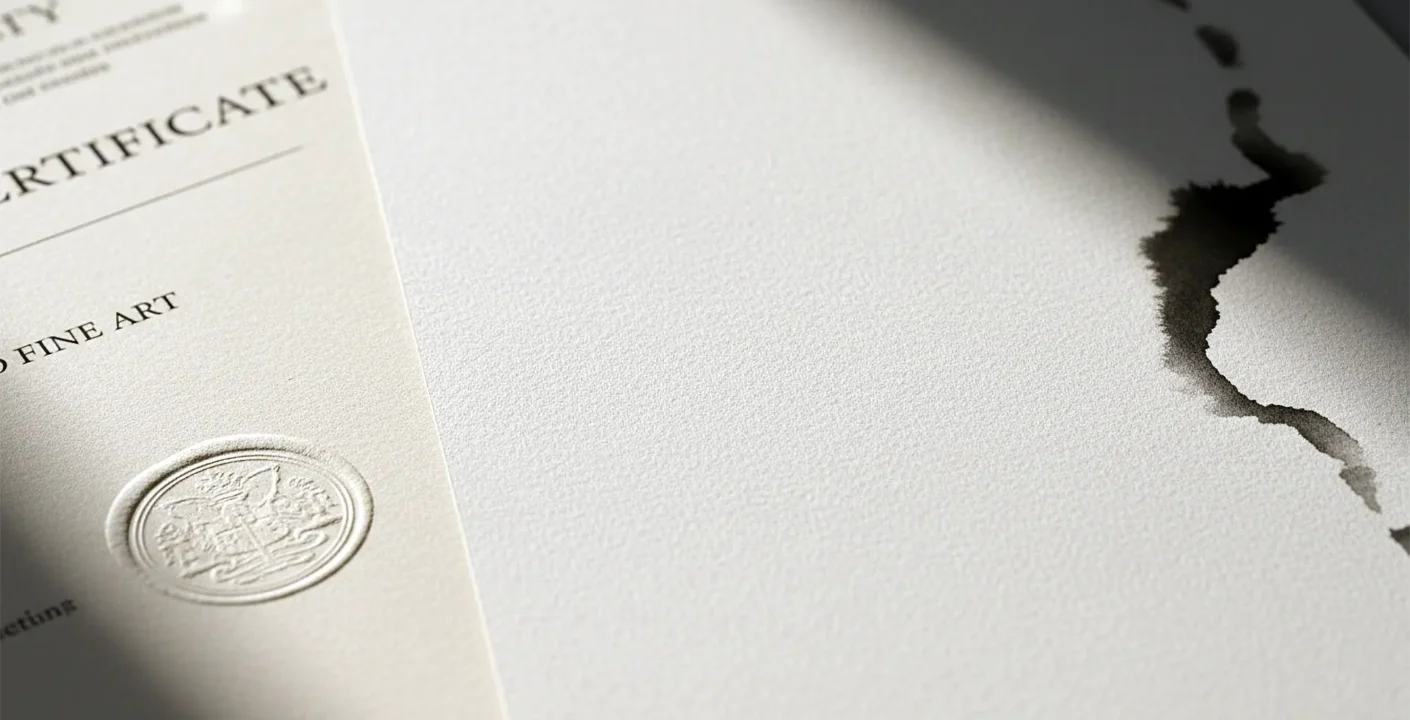
Every work from Umbra Studio includes a Hahnemühle FineArt Certificate of Authenticity, issued by the manufacturer of the substrate itself.
This matters for reasons that go beyond pride of ownership.
The Hahnemühle certificate physically links the work to a verifiable production batch. It documents the paper, the printing technique and the producing studio. In collecting terms, it constitutes the first layer of provenance — the chain of origin that collectors, insurers and auction houses require to value, insure or reintroduce a work into the market.
A print without verifiable certification — however beautiful — cannot be appraised by any serious valuator. It cannot be insured as an art object. It cannot enter a collection governed by investment criteria.
The certificate adds no aesthetic value. It adds legal and material existence to the object as a work of art.
What is actually being purchased
There is a more direct way to think about this.
When you purchase a print from a low-cost online service, you are purchasing the image. The substrate is irrelevant. Scarcity does not exist. Durability is not guaranteed.
When you purchase a work from Umbra Studio, you are purchasing:
- A physical object produced on 308 g/m² pure cotton, with documented longevity exceeding a century.
- One of exactly nine copies in the world, hand-numbered and signed.
- A certificate of authenticity issued by the substrate manufacturer, with full traceability of the production process.
- A work integrated into a curated collection with a curatorial narrative, named from Latin or Greek etymologies, conceived to endure as discourse as well as object.
- The genuine — not speculative — possibility that this object will be worth more the day you choose to sell it than the day you acquired it.
That is the price. Not the price of the image. The price of the object, its scarcity and its future.
A final note on the value of AI-generated art
It is worth stating clearly, because the conversation around art and artificial intelligence tends to generate more heat than light.
Umbra Studio produces works generated with AI under deliberate human artistic direction: concept, palette, composition, narrative and selection are decisions made by the studio — not random outputs from an automated system. AI is the medium, just as photography was in the nineteenth century or screen-printing in the twentieth — both initially rejected as “not art” and both now present in the finest collections in the world.
What determines the value of a work is not the technology that produced it. It is the intention behind it, the material in which it exists and the scarcity that makes it singular.
In that sense, a fine art print from Umbra Studio does not compete with Etsy. It competes — and can do so with full legitimacy — with any contemporary gallery limited edition.
Explore Umbra Studio’s active collections and discover available works before each edition closes permanently. → Bonsai · Metamorphōsis · Liminal · Nobilis · Abyssos · Stoa