
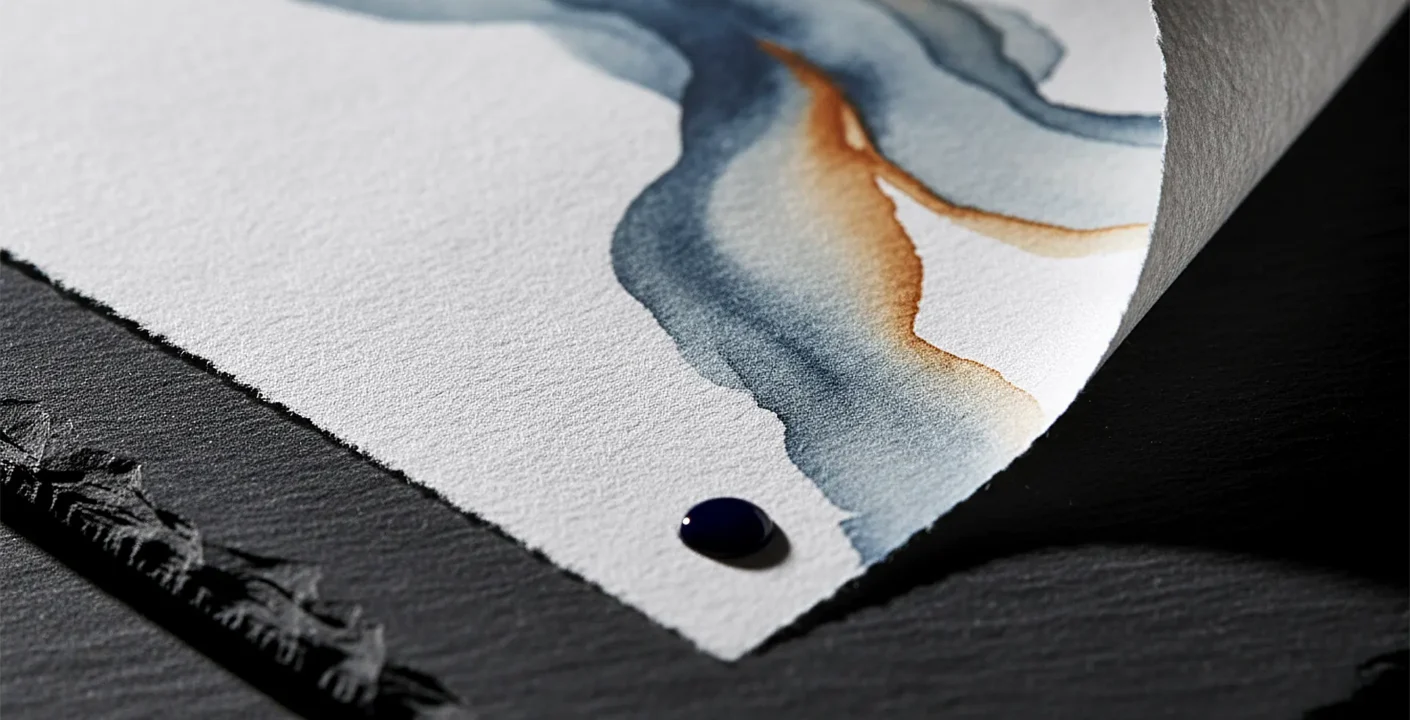
The paper that turns a print into a work the passage of time cannot erase.
Some decisions are made once and define everything that follows. The choice of paper is one of them.
When Umbra Studio set out to produce limited-edition fine art, one question determined everything: what substrate is worthy of the works we are creating? The answer was not difficult to find. Hahnemühle Photo Rag 308 g/m² has been the reference paper in museums, galleries and institutional collections around the world for decades. We did not choose the best available paper. We chose the only paper we would never question with time. This article explains exactly why.
1. A paper that is, in truth, a fabric
Hahnemühle Photo Rag 308 g is not paper in the conventional sense. It is manufactured from 100% pure cotton fibre — no wood pulp, no synthetic fillers, no compromise. The result is a surface that the eye reads as paper but the hand recognises as something different: softer, denser, with a tactile memory that ordinary papers do not possess.
That texture is not an aesthetic accident. It is the direct consequence of the raw material. Cotton has a long-fibre structure that gives the paper exceptional mechanical resistance and, simultaneously, a receptiveness that allows ink to settle with millimetric precision. The works of the Liminal collection — with their gradations of slate blue, crepuscular amber and luminescent white — demand that kind of precision. We cannot allow the substrate to interpret what the artist has defined.
Cotton remembers colour exactly where it is asked to remember it.
The 308 grams per square metre are not merely a technical specification: they are the physical presence of the work. When an Umbra Studio print reaches the collector’s hands, its weight says something before the eye has finished looking. It says: this was made with intention.
2. Colour reproduction: absolute fidelity
Hahnemühle Photo Rag 308 g has a smooth matte finish that eliminates reflections and allows the eye direct access to the work — without luminous interference, without the mirror effect that undermines contemplation. For a piece designed to be hung, looked at and lived with for years, this detail is not small.
Its technical coating is compatible with high-density pigment inks — the same ones we use in our 12-colour giclée printing technology. That compatibility is not automatic: many papers of similar weight degrade ink over time, altering the original chromatic range. Photo Rag not only avoids this — it actively preserves it. The relationship between substrate and ink is designed to be stable, permanent, unalterable.
Umbra Studio works are built on a very precise chromatic dialectic: cold blue against burning amber, luminescent white emerging from darkness, microscopic sparks imitating starlight. That visual language requires a paper that takes no side — that neither warms nor cools tones on its own. Hahnemühle Photo Rag is neutral in the most technical and most artistic sense of the word: it serves the work, not itself.

3. Durability: a work for generations
Collecting art is not simply acquiring a piece for the present. It is the decision that this piece will have a future — that it will remain what it is in ten, thirty, one hundred years. The substrate cannot be the limiting factor in that ambition.
Hahnemühle Photo Rag 308 g is acid-free and lignin-free — the two agents responsible for the yellowing and degradation that turns ordinary paper into a fragile relic over time. Its formulation guarantees image stability exceeding 100 years under standard domestic conservation conditions. Under archival conditions, that figure extends considerably.
Hahnemühle has been making paper in Dassel, Germany, for more than 450 years. The company that chose to produce paper for Rembrandt, Dürer and the great masters of Western printmaking has not changed its commitment to permanence. Neither have we.
An Umbra Studio work is not a decorative print. It is an object that can outlive those who acquire it.
4. The finish that serves the art — not itself
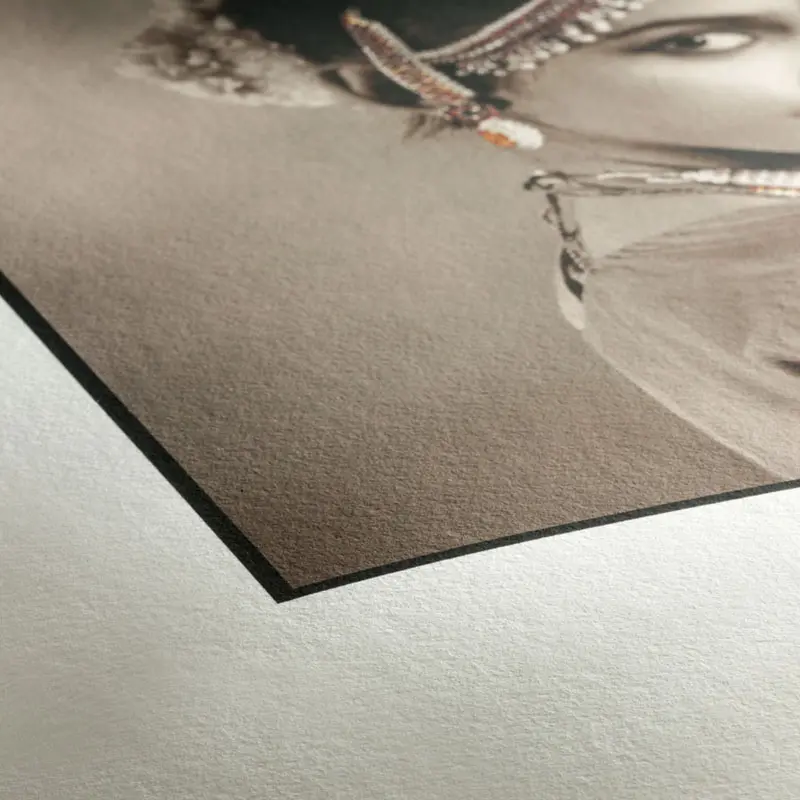
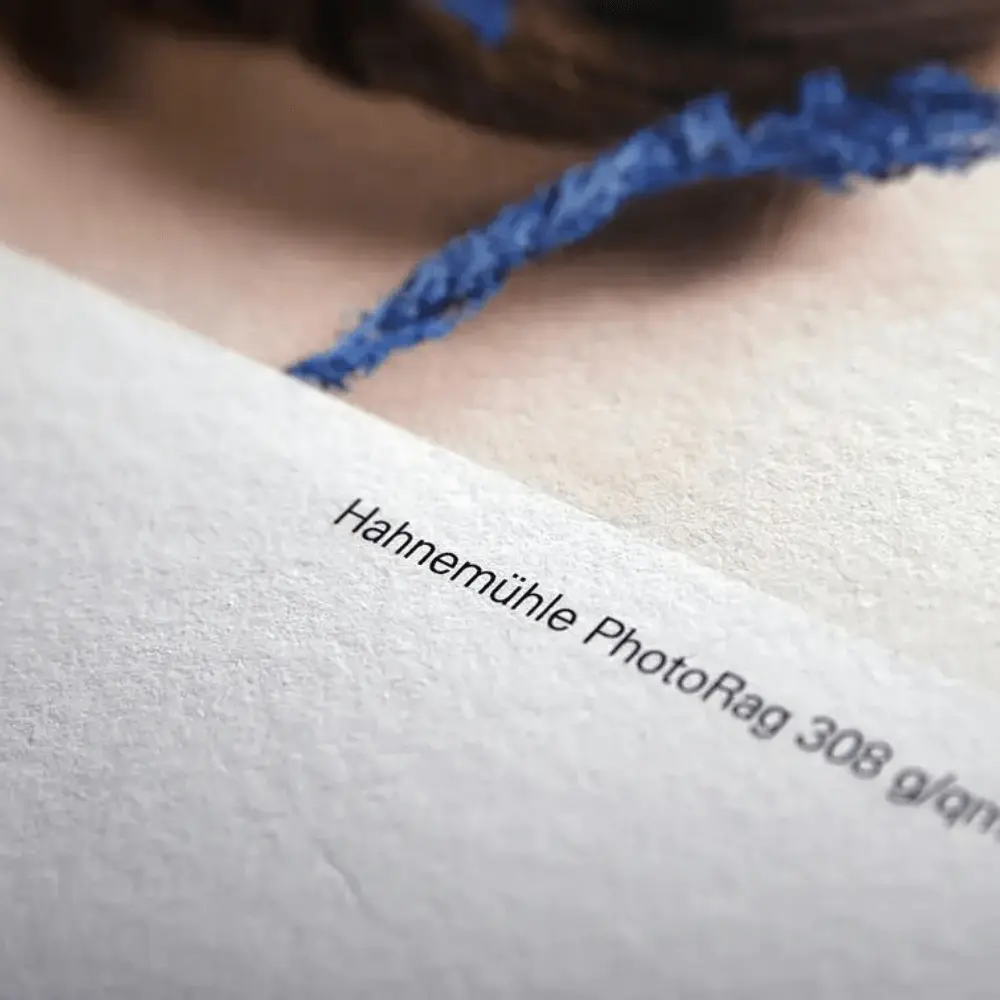
Photo Rag 308 g has a subtle but perceptible texture — a microstructure that gives it visual depth without interfering with image detail. It is not the smooth paper of commercial photographic reproductions, nor the rough paper of antique lithographs. It occupies a middle ground that the fine art world took decades to refine.
Its base tone is warm white — slightly warm, with exactly the warmth that prevents the luminescent whites of Liminal collection works from reading as cold or artificial. A neutral white, by comparison, would have given those same works a clinical quality. Photo Rag contributes the right temperature.
This versatility has practical implications for the collector: Umbra Studio works perform equally well framed, mounted on stretchers, or presented unframed with the edge visible. The paper has sufficient weight to present itself with dignity in any configuration.
5. Sustainability: permanence is also responsibility
Hahnemühle produces Photo Rag to certified sustainability standards. Manufacturing from cotton fibre — a renewable natural resource — and the environmentally responsible production processes the company has maintained since its founding in the sixteenth century reflect a long-term philosophy consistent with our own.
At Umbra Studio, we believe that art which aspires to endure has an obligation to be produced with materials that do not compromise the future. Photo Rag is not only the best technical choice — it is also the most responsible one.
Technical Specifications
Print Medium · Fine Art
Hahnemühle Photo Rag 308 g/m²
Dassel, Germany — founded c. 1584
Physical Specifications
| Manufacturer | Hahnemühle Fine Art — Dassel, Germany (founded c. 1584) |
| Reference | Photo Rag 308 g/m² |
| Composition | 100% cotton — acid-free and lignin-free |
| Weight | 308 g/m² |
| Finish | Matte, smooth surface with subtle textile micro-texture |
Printing & Archival
| Base Tone | Warm white |
| Compatibility | High-density pigment inks / 12-color giclée printing |
| Longevity | Over 100 years under standard archival conditions |
| Certifications | Acid-free · lignin-free · compliant with ISO archival standards |
| Use at Umbra Studio | Exclusive medium for all limited editions across every collection |
The choice that does not change
At Umbra Studio, every work is the result of a long and deliberate process: the creation of the image, the curation of the collection, the numbered edition, the certificate of authenticity. None of those steps would have meaning on a paper that was not equal to what precedes it.
Hahnemühle Photo Rag 308 g is not the most economical option. It is the correct one. And for our collectors — people who choose with care, who understand that what they acquire must live alongside them for decades —, that is precisely the distinction that matters.
We print on the finest paper in the world because the works we produce deserve a substrate that does not age before their meaning does.