Description
Silence has topography. It has surface, texture, scale. And to chart it, one must stand upright before it.
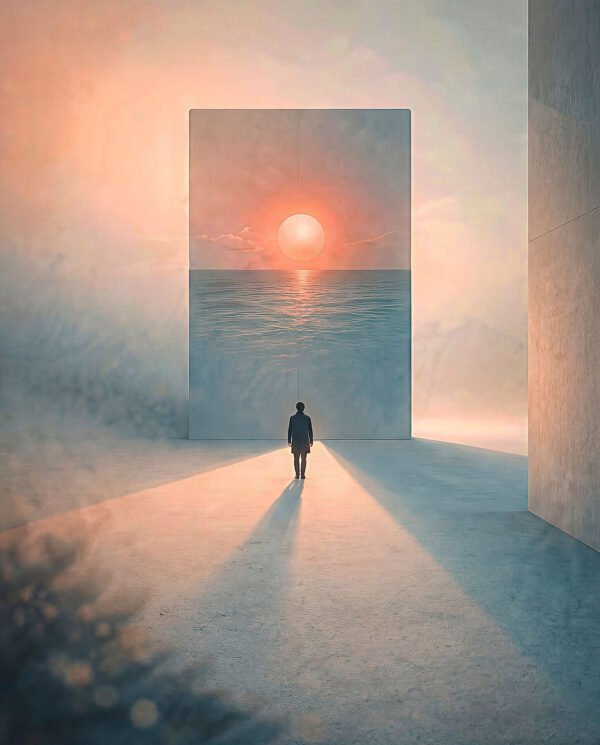
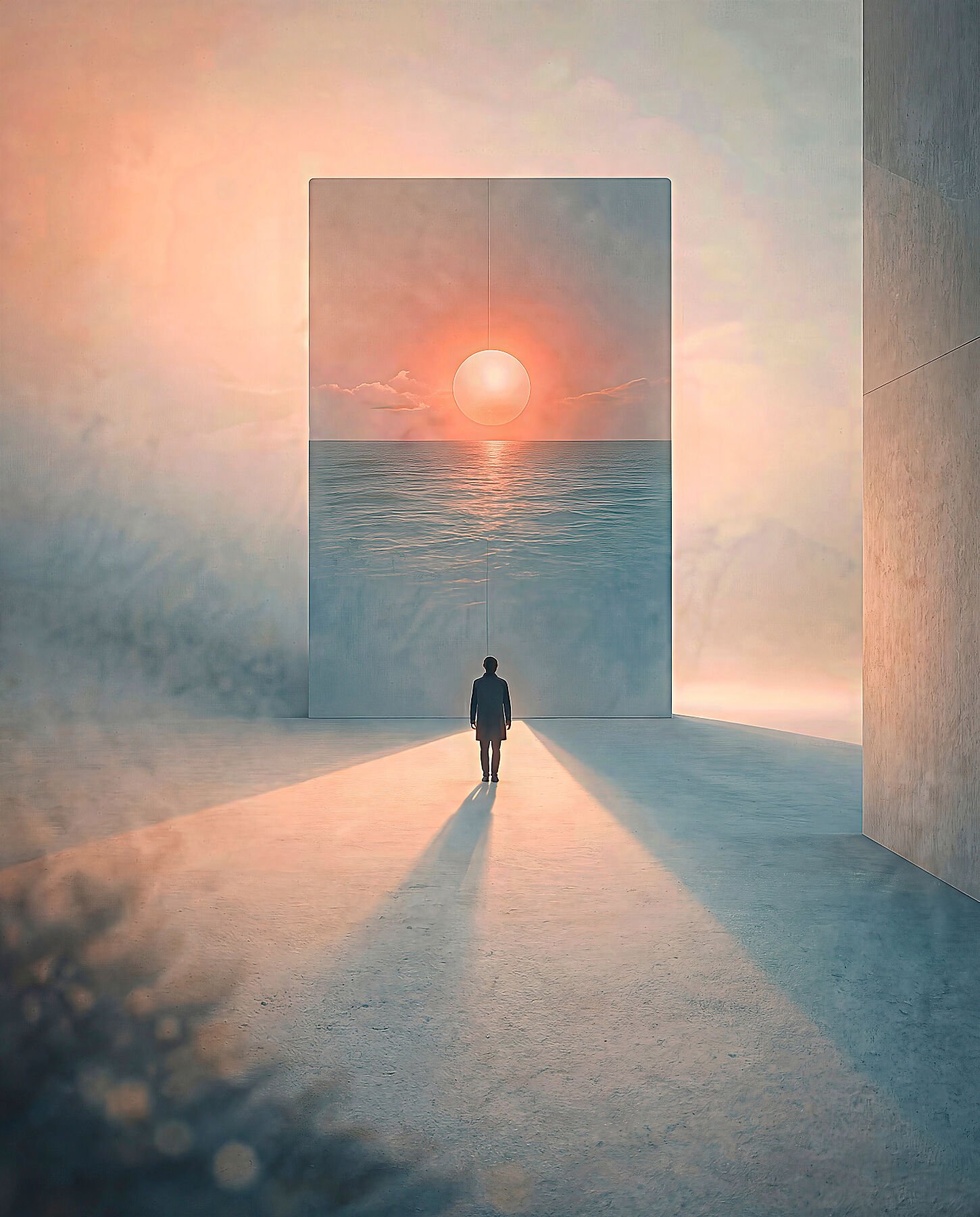
Topography of Silence introduces for the first time in the Liminal collection a figure that reads as masculine — or at least, one without the stylistic attributes that have defined the series until now. It is small. Deliberately small. Dressed in everyday clothes, seen from behind, motionless before a monolith of dimensions that entirely transcend it. There is nothing heroic in its posture. There is something more difficult: presence.
The monolith is not a screen, nor a painting within a painting — although it resembles both. It is an aperture. A stone window opening onto another time, another climate, a sea that does not belong to this architectural space of cold mist and concrete. Within that perfect rectangle lives a marine sunset: the sun at its precise moment of contact with the horizon, vast and soft, pouring across the water a trail that reaches the figure’s feet like a personal summons.
And the figure receives it. Does not cross through it. Does not flee. It stays.
The shadow is the compositional element that elevates this work above any other in the collection. Long, perfect, cast at an angle by the light emanating from the monolith, it projects toward the viewer like an inverted arrow. This is not the shadow of someone walking — it is the shadow of someone who has chosen to stop. Who has found the exact place where silence carries the most weight. That shadow is us, receiving the light the monolith emits, interposed between the landscape and the world.
The mist enveloping the architectural space is not threatening. It is protective. It dissolves the edges of the scene with the same delicacy with which dreams dissolve the architecture of the day. The concrete walls — present to left and right, out of focus — anchor the composition in the constructed without surrendering it to the eternal. They are there to remind us that this is not a landscape found: it is a landscape made. A space designed so that someone, one day, would arrive here and stop exactly like this.
The connection to Architecture for a Red Sun and Door to a Sea of Mist is explicit in formal language — all three share the logic of the architectural threshold and the sun as axis — but Topography of Silence takes the step the other two do not: it places someone inside. And in doing so, it converts the viewer from protagonist to witness. We are no longer the ones standing before the threshold. We are the ones watching someone else do so.
And in that distance, something is revealed: that true contemplation always looks like this. A solitary figure, turned away, small before the infinite — with no intention of reducing it, and no intention of fleeing.
Simply, here.
Art Giclée Printing
Works reproduced with printing technology of 12 intense and natural colors
Shipping information
International shipping of art printing, frame and framing.
100% Secure Payment
Your payment information is secure